


Whisking by Warsaw

Is it possible to explore a city in one and a half days? That might never be enough, but if given a choice between seeing and not seeing a new city, I would undoubtedly opt for the former. So that's what we did during our 2024 trip in Europe, when we needed to break up a long journey from Prague to Vilnius. Being almost equidistant from both cities, Warsaw presented itself as the obvious choice for a two-night stopover.
Prague to Warsaw
Our Flixbus from Prague to Warsaw took about eight and a half hours. The tickets, bought just the day before, cost 3,156 Czech Koruna or AUD 202.94. It was a no-frills bus ride with neither onboard entertainment nor a charging port. We reached the Warsaw West bus terminus at around 2:30 pm and booked an Uber to the Airbnb. It took us so long to figure out the layout of the bus terminus and locate the pick-up spot that the first Uber cancelled the trip. We rebooked, and after a bit of toing and froing, we made it to the pick-up spot, just in time. The busy Thursday afternoon traffic prolonged our journey. We reached the Airbnb around 3:30 pm.
Whatever Is Left of the First Day
The delay led to us cancelling our visit to the POLIN Museum of the History of Polish Jews as we couldn't have made it there before 4:00 pm, the last cut-off for the entry to the main exhibition. Instead, after unpacking, we decided to take a stroll in the neighbourhood to get a sense of the surroundings and to source some sustenance.
We found a bakery and confectionery called SPC. They had a beautiful collection of desserts and trays of pierogis even at 5:00 pm. As neither shop assistant spoke any English, our communication was aided mainly by Google Translate and gestures, but the funniest exchange took place when we enquired about the filling of a tray of pierogis, and the younger of the shop assistants snorted like a pig! We all laughed. We bought two blueberry cupcakes with cheese filling and three Polish donuts (pączki) for 11.97 Polish Zloty.
With dessert sorted, it was time to find the main meal. Not far from the SPC was a SPAR supermarket. We bought the usual: milk, fruit, baked goods, and frozen meals for dinner. I wanted to pay by card but made a mistake when choosing the currency. The lady at the checkout wasn't happy! I apologised profusely in English but when her expression remained unchanged, I realised she spoke no English. When the payment finally went through, I said dziękuję (jen-koo-ye) - 'thank you' in Polish. Did I catch the faintest smile on the lady's face? I would like to think so!
We went to bed early that night as we wanted to make the most of the next day.
The Only Full Day in Warsaw
Day two started, as hoped, quite early. We left our Airbnb in Karmelicka around 7:30 am. It was a kilometre's walk to the tram stop, wherefrom we caught the tram to the Warsaw Rising Museum, our first destination for the day. We bought two Zone 1 regular tickets for Tupur and me and a reduced ticket for ShNaajh from a roadside ticket machine. They cost 37.5 Polish Zloty, which was equivalent to AUD 14.84.
Warsaw Rising Museum

Entry into the Warsaw Rising Museum cost us 100 Polish Zloty (AUD 33.63). The museum represents a significant chapter of local history that centres around the Polish Home Army insurgency against the occupying Nazi German forces. Backed by the London-based Polish government-in-exile, around 40,000–50,000 Polish resistance fighters, many poorly armed, launched a coordinated attack across the city with the single goal of liberating Warsaw from German occupation. Irrespective of initial success, the brutal Nazi counterattack with heavy ammunition led to the loss of 150,000–200,000 Polish civilian lives and eventually the systematic destruction of the city.

Beginning on 1 August 1944, the resistance only lasted 63 days. The movement may have been short-lived, but it was a proud chapter in local history, symbolising hardship, persistence and most importantly, heroism in the face of death and destruction. Through pictures, videos, sound effects, first-hand accounts of survivors, objects possessed by Varsovians of that time and remnants of buildings damaged by the Nazi forces, the museum has manged to create a time capsule that can teleport visitors to the dreadful times when Warsaw was under siege. Perhaps the most striking part was the visuals from the 3D short film. It was more of a recreation on the basis of pictures taken of the destroyed city in the aftermath of World War II. The sight of the city being brutally destroyed and decimated to rubble made me feel numb. The sense of shock, frustration and anger caused by the destructiveness of humankind was hard to describe. Unfortunately, the powerful imagery is lost on our race. 80 years later, we are making the same mistakes. Will we ever learn?
The Statue of Nicolaus Copernicus

We had to rush through the last section of the museum, which focused on Poland under the repressive Soviet regime, to reach the meeting point of our Welcome to Warsaw - Historic Centre Guided Walking Tour scheduled for 10:30 am. With the help of Google Maps, we managed to take M2, one of the two metro lines that crisscross the city, to Nowy Świat-Uniwersytet, the closest metro station to Nicolaus Copernicus Monument, our next stop.
Born in Torun, Poland, Nicolaus Copernicus (1473 – 1543) redefined astronomical science through his revolutionary heliocentric (sun-centric) model of the solar system. He was the first human being to point out that the Earth rotates on its axis daily and takes a year to revolve around the sun. With expertise in an array of subjects, Copernicus is a revered figure in Poland. Even Germans respected him for his achievements. As a result, the occupying Nazi forces left his statue intact even though the buildings around it were destroyed. In its current location at the front of the Polish Academy of Science, Copernicus is seen looking in the direction of the sky with navigational tools in his hands. This iconic statue was the starting point for our walking tour of Warsaw's historic centre.
The Church of the Holy Cross

We were at the meeting point of our 2.5-hour walking tour around 10:10 am. Having about twenty minutes to spare, we decided to explore the vicinity. It was hard to resist the charm of the Church of the Holy Cross, a Baroque landmark. We ventured inside, hoping to see a beautifully decorated pulpit, remarkable interior decoration and a massive organ - features commonly associated with European churches, and we weren't disappointed. However, little did we know that the church was the resting place of the literal heart of the famous Polish composer Frederic Chopin. The heart is kept inside the first pillar on the left-hand side of the church. Chopin died in Paris in 1849. He wanted to be buried in his country of origin. It is believed that Chopin's sister smuggled the embalmed heart through Customs at the Austrian border to respect the dying wish of one of the world's most celebrated composers and gave it to the church.
Another interesting aspect of the church was the monument to Pope John Paul II, a Polish native. The relief of the third-longest-serving head of the Catholic Church with his raised hands made the man look quite lifelike. Later, our walking tour guide compared the figure of the Pope pushing out of the wall to Casper the Friendly Ghost. I don't blame him!
Walking Tour of the Historic Centre

We met our walking tour guide at 10:30. He was knowledgeable and passionate and had a quirky sense of humour. He refused to play the game where his name could be Kim but he wouldn't mind being called Charlie. He said he'd rather stick to his name, and we shouldn't be offended if he didn't respond to being called Jack. His name was Jacek and that's what we called him.

We learnt that most of the buildings in the historic centre of Warsaw weren't historic. They had been destroyed during World War II, and the city was rebuilt mainly between the end of the war and the mid-1960s, with some construction ending in the 1980s. It was undoubtedly a mammoth task and a testament to Varsovians’ true grit. Like the mythical bird Phoenix, the newly built Warsaw was created from the ashes of the old town, literally. Original material recovered from the rubble was used in the rebuilding process. Interestingly, it was possible due to the elaborate landscape paintings of a somewhat unknown Italian artist Bernardo Bellotto. As a court painter of the Polish kings Augustus III and Stanislaw II, Bernardo spent the last 13 years of his life in Warsaw. Little did he know that his art would form the basis of the rebuilding and restoration of Warsaw’s historical and cultural identity nearly 165 years after his death. If the Warsaw Rising Museum was an emblem of the destruction of Warsaw, the newly built Old Town represented its rejuvenation.
From the statue of Nicolaus Copernicus, we took the Royal Route, which went past some of the most important landmarks in Warsaw, including the University of Warsaw, the Roman Catholic Church of the Visitants, and the five-star hotel duo Raffles Europejski and Hotel Bristol.

We paused at the iconic Presidential Palace, the largest of all the places in Warsaw, with a four-storey main body and two lower side wings. The aristocratic and purpose-built modern structure hosts the President when he is in town. Poland’s red and white flag, which symbolises bravery, sacrifice, and hope for peace (, which Jacek refreshingly called the little joys of life), was flying high on top of the building, flanked by the NATO flag to the right and the EU flag to the left. Jacek said the alliance with NATO and the EU was extremely important to Poland due to its geopolitical situation, i.e. bordering with Russia, Belarus and Ukraine. They guarantee an extra layer of security in turbulent times, especially with the ongoing Russia-Ukraine war. Entry into the Presidential Palace and guided tours are free; however, they have to be pre-booked.
Another notable landmark was Krakowskie Przedmieście 66, which had strong ties with Marie Curie, the Warsaw-born Physicist and Chemist, and the first female recipient of the Nobel Prize in 1903. Within the humble walls of the block above, Marie worked as a teacher so she could save enough money for her studies in Paris. She met her future husband and research partner, Pierre, in Paris. Their work on radioactivity won them the 1903 Nobel Prize in Physics. Pierre was apparently the only recipient of the prize, but he refused to accept it if Marie's contributions were ignored. The Nobel Committee complied. Later we came across the Maria Skłodowska-Curie Museum but did not have time to visit.
Our walk continued to Castle Square, where the Royal Castle is, and the Sigismund Column. We took a short break here. Jacek pointed at the Warsaw Stadium - Stadion Narodowy. Football is an important part of the Polish psyche, as are culture and politics.
We walked on to the Old Town, which, Jacek said, was the size of a football field. It started at St John's Archcathedral, possibly the most un-Gothic-looking Gothic church there is! We walked the cobblestone streets of the medieval core of Warsaw and arrived at a quaint square with a 17th-century handmade bell right in its middle. The bell apparently never rang because it had a crack. It grants wishes though. For a small wish, you have to walk around it once, and for a big wish, three times. Jacek also showed us the narrow corner house at the square. Narrow because the wider the house was in the Middle Ages, the more taxes the owner had to pay. There was also a piece of the Goliath tank mine track embedded in the back (or side?) wall of the Cathedral. The German tank destroyed part of the Cathedral walls during the Warsaw Rising.
We went past uniquely painted houses to get to the building-locked Old Town Square. Even there, the designs of the buildings concocted a charm that made the passing visitors pause and marvel at their beauty. I am unaware of any other newly built old town. I suppose there are more of them in Europe due to the destruction caused by the World Wars; however, Warsaw’s recreation of its historical past captivated us.
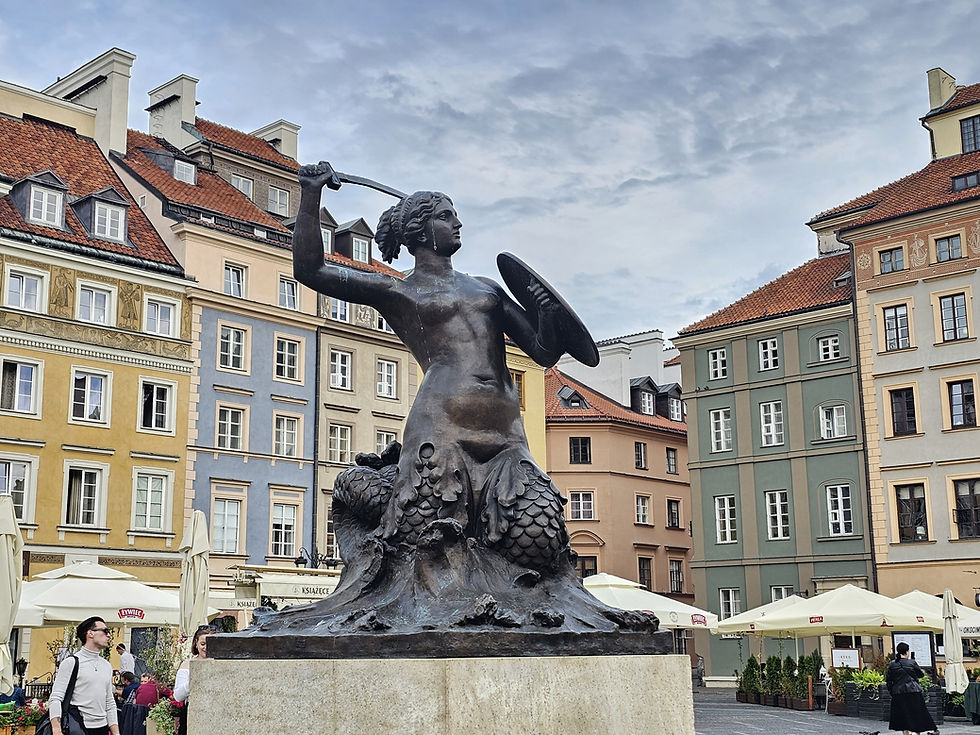
In the centre of the square was the statue of Syrenka, the Mermaid of Warsaw. Unlike the Little Mermaid in Copenhagen, Syrenka has two tails and a bold posture. She seems to be rising from the waves of the sea, and with a sword and a shield in her hands, looks fierce and ready to protect her beloved city. According to local folklore, Syrenka came to the Old Town via the Vistula River. She fell in love with the city. She brought joy in people’s lives through her beautiful singing voice. Unfortunately, a greedy local merchant captured her and held her prisoner. After she was rescued by the locals, as a sign of her gratitude, Syrenka promised to protect the people of Warsaw from harm’s way.
The walk ended at the Warsaw Barbican, largely a reconstruction of the historic fortifications that once protected Warsaw.
St. Anne's Church and the Viewing Platform
After a satisfying lunch at Zapiecek, the remaining activity on our list was a climb to the top of the Bell Tower of St. Anne's Church. We paid 27 Polish Zloty for our tickets and climbed the 147 steps, which would've been a piece of cake had we not consumed a wholesome midday meal half an hour ago. Once on top, we forgot about our toil. The viewing platform offered the best panoramic view of the Old Town, the Vistula River and the modern Warsaw skyline. We explored all four sides of the platform, took some pictures and then paused momentarily to absorb the beautiful view.
As we descended from the bell tower, a feeling of sadness engulfed us. It was possibly the realisation that our day in Warsaw had come to an end. With an early morning start for Vilnius looming, we had to return to our Airbnb early. It had been a long and fulfilling day. Warsaw had given us more than we expected: a taste of resilience, beauty, and history. It fed our curiosity and left us craving for more. With a tightly packed schedule, we couldn’t afford another day here, but perhaps that’s the beauty of travel: leaving a piece of you behind, with the hope of returning.


Very nice journey
I absolutely enjoyed this article. I found it incredibly relatable. The writer perfectly captured the mindset of budget conscious sub continent travelers, offering practical tips on accomodations, public transport and must visit spots. It really made the European experience accessible and enjoyable. A big thank you to the writer for that.- Biplab
Congratulations Rakesh da on such a wonderful article.
I have just read the entire piece. It's a really insightful and thoughtful reflection on the city's resilience. Taking that quick trip to Warsaw was a really good decision.
Amazing story, enjoyed reading.
Europe has lots of places to offer. Nice to know about Warsaw. Feeling motivated to visit those places in future.