


Uzbekistan: Unknown, Underrated and under the Radar, but Not for Long! Part II

Day Two
We had a full day to sightsee in Tashkent before boarding the train to Bukhara the next day.
Before we could begin our sightseeing, we had two important tasks to accomplish. We needed to exchange our US dollars for some local currency and Simon needed a local SIM card.

For the first task, I was relieved to discover a bank close to our apartment building. Moneychangers were almost non-existent in Tashkent and guide books advised tourists to change at banks, which offered a reasonable exchange rate. Simon already had enough from the exchange he did at the airport yesterday. I managed to change USD300 into thousands of Uzbek Soms. One US dollar was about 11,600 UZS (Soms). I was definitely a millionaire in Soms when I left the bank!
Simon found a mobile phone provider nearby and registered himself for a local number. We needed a local card to summon Yandex cars, the local version of Uber.
After settling these two matters, we set off. Our first stop was the Kukeldash Madrasah, which was within walking distance from our apartment. On the way there, we passed by some stalls and shops selling religious clothing, books and Islamic paraphernalia - Quran-reading stands, posters, and banners with Quranic verses written in calligraphy, among other things. The reality hit me then - this was indeed a very Muslim country, more so than in Malaysia. Modesty-wear was widely sold. However, the head covering for women wasn’t compulsory. About half the women there didn’t wear one. Very few hid their faces under a veil.
Kukeldash Madrasah

Kukeldash Madrasah was located in the Old Tashkent area, near Chorsu Bazaar. Madrasah was a religious centre of learning. This madrasah formed a part of Old Tashkent’s main city square called the Registan.
This splendid, rectangular, two-storeyed structure had a huge 20-metre portal or gateway (Iwan) leading into a calm, green inner courtyard filled with plants and trees. It was framed by a minaret (Guldasta) at both ends of its façade. The portal, minarets and windows of the cells were decorated with iconic glazed majolica tiles of sky blue, royal blue, white and ochre. Woven into the patterns of the window lattices were the calligraphic writing in yellow (Pandjara) of ‘Allah’ and ‘Prophet Muhammad’. I would be seeing plenty of this kind of architecture throughout my stay in Uzbekistan.
The aforementioned cells (Hujras) served as living quarters for the theology students who resided in the madrasah. There were 38 of these cells there.
Kukeldash Madrasah was built during the reign of the Shaybanid Dynasty by the vizier Dervish Khan in 1570. Due to his close relationship with the ruler at that time, Dervish Khan was nicknamed Kukeldash, meaning the Khan’s (the ruler’s) milk brother or foster brother. Thus, the madrasah built by him took on his nickname.
We took some photos there and looked down at the incessant traffic below. Kukeldash Madrasah is located on a small hill overlooking the wide boulevards of Tashkent with its endless stream of vehicles and the furious blaring of car horns.
Hoja Ahror Valiy Mosque
The Hoja Ahror Valiy Mosque is located next to the Kukeldash Madrasah. We headed there next. It was also called the Dzhuma Mosque (Friday Mosque). It was built in 1451 by Sheikh Ubaydulla Khoja Ahror (1404 – 1490). This Sheikh, who was a Sufi practitioner and a descendant of Prophet Muhammad, was famous and respected due to his ascetic lifestyle, generosity and assistance to the Tashkent people during the famine of the 1430s.
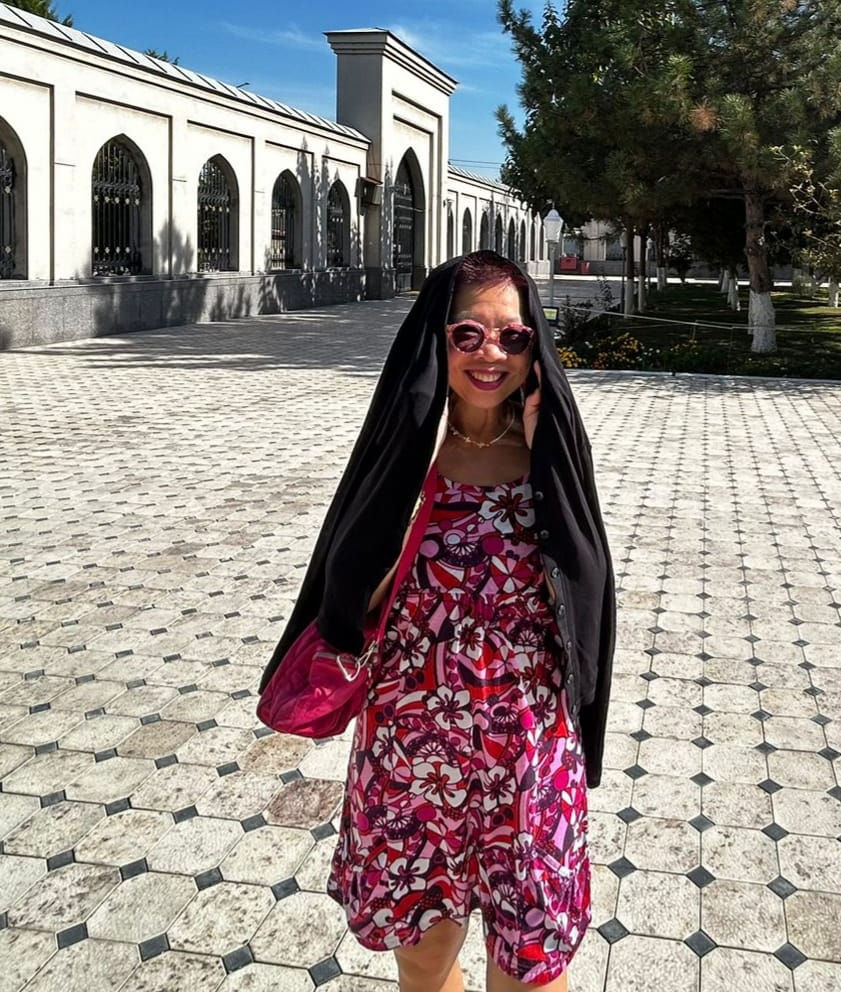
Hoja Ahror Valiy Mosque was a huge white building with a pale blue tiled gateway and three very visible teal domes. There was a big sign outside telling visitors what NOT to wear into the mosque. I just had a very brief look inside as it was a 27-degree day and I was in a forbidden sleeveless dress.
This mosque had an elongated rectangular and very spacious courtyard. The interior of the mosque looked tremendously spacious too. It ranks third in Uzbekistan in terms of its scale and significance, after the Bibi-Khanym Mosque in Samarkand and the Kalyan Mosque in Bukhara. It is also the oldest of the 157 mosques that are found in modern Tashkent.
Chorsu Bazaar
The highlight of Old Tashkent was Chorsu Bazaar, a circular building with arches all around, topped by a massive dome of blue and turquoise tiles. From afar, it looked like a spaceship! Being a covered building, the stalls inside the bazaar were arranged in concentric circles on the ground floor. On the first floor, there was a wide terrace circumnavigating the edges with more stalls and tables selling dried foods. When we looked up, we noticed that the ceiling of the dome was designed with a silver webbed pattern, stretching all the way towards the central skylight, creating an incredible visual effect. It was actually the exposed steel frame of the structure on display. The diameter of the dome was between 300 to 350 metres.
Chorsu is a Persian word meaning ‘crossroads’ or ‘four streams’. The bazaar is located at an intersection of four roads. It is one of the oldest Central Asian bazaars and was known as far back as the Middle Ages as an important Silk Road destination. Over the centuries, it has been restored and renovated.

As for our visit to Chorsu, we actually made our way to it through the back. There were many, many makeshift stalls surrounding the periphery of this bazaar. We saw stalls selling clothing and fake jewellery. Then, there were stalls selling tiny grape-like fruits called mountain apples. They came in hues of red, orange and yellow. Simon bought some and I tried them. They tasted sour and not very nice at all!

A new product we encountered was Kurts. There were golf-sized or smaller balls made from the sour milk (or yogurt) of sheep, goats or cows. They were fermented and dried, transforming into tangy but salty bite-size snacks that pilgrims, nomads and merchants would bring along with them as they journeyed across Central Asia in the hot steppes and deserts. Foreigners called them Uzbek cheese balls. They were nutritious and densely moist, satisfying both hunger and thirst.
When we finally set foot inside the huge domed market, I let out a gasp. It was humongous! And it was teeming with both sellers and customers. We saw the green herbs and vegetable stalls, the array of colourful spices displayed in plastic boxes, the heaped mountain tea leaves, all sorts of dried fruits and nuts, including dried Cantaloupe (they were called the Uzbek melon as they were longer and of a brighter yellow shade compared to a regular cantaloupe), and tons of lemons and chocolate persimmons.

The youth who was selling the Chocolate Persimmons cut one open to show me that it was brown inside, hence the name. The exterior was still a bright orange with slight hints of brown. I was curious to taste them, so I bought some to try.
The meat section was astounding! Uzbeks loved their meat, and by that, I mean goat, sheep, cow and HORSE meat. A huge signboard above a row of stalls had a picture of a horse prominently displayed. That signalled to customers where they could purchase horse meat or horse sausages. All the butcher stalls were located in the inner concentric circles as if they would circle themselves to infinity. It amazed me that there was enough demand from the customers in order for the vendors to make a profit! I guess in a city of three million people, you would be able to do so!

One particularly nauseating product at the meat section was lamb fat. Yes, there were huge cylindrical blobs of lamb fat
on sale. Similar to the pig fat in Ukraine called Salo, Uzbeks ate it to keep themselves warm. They were absolutely disgusting to the eye.
After touring the ground floor, we climbed upstairs to the first floor. There were more stalls here, selling non-perishable food such as dried fruit and nuts, spices, candied fruit and Navat. Navat was a traditional Uzbek sweet consisting of crystalised sugar. It was made from grape juice and concentrated sugar syrup with the addition of various spices. Navat could also be stirred into tea as a sweetener.
Further away, we came across the handicraft and artisan section. The first ‘house’ we visited was the Ishkor centre. Ishkor referred to the very colourful and bright Uzbek ceramics and pottery. The Uzbeks, especially the craftsmen in Rishtan, used a glazing technique called the Ishkor glaze, which dated back to the days of the Silk Road. It used the ashes of a desert plant called Ishkor and mixed them with crushed quartz. Pottery that was made with this incredibly durable glaze produced a beautiful soft blue-green lustre. Besides the manifold household utensils, there was also a wide variety of figurines depicting Uzbek people in daily life. They were very pretty to look at and made for excellent souvenirs.

Another item worth mentioning was the ubiquitous Suzani or tapestry pieces that have innumerable functions. Suzani came from the Persian word Suzan, meaning needle. They could be used as carpets, rugs, prayer mats and bed sheets, or for sitting, or simply hung on walls as a display item. In nomadic life, pieces of furniture were rarely found in yurts because they were cumbersome to move. Hence, people sat on Suzanis. They were also used as protective wrapping panels for belongings in the yurt.

After the onslaught on the senses in Chorsu Bazaar, it was finally time for lunch. I didn’t even have breakfast that morning! We found a place called Lagman House, about a 15-minute walk from Chorsu. Lagman was the Uzbek word for la mien (pulled noodles) in Chinese.

The restaurant had a pleasant and relaxing atmosphere. We ordered four items. The first one was a fried noodle dish with beef. The second was a soupy pulled noodles. The main ingredients were lamb, wood fungus, capsicum and onions. The bowl of soup was served separately. It was up to us to mix them. A popular drink here was green tea with lemon and mint served in a teapot. We requested a sugarless one, of course. That was the third item. My fourth item was the Napoleon cake. It looked like a multi-layered vanilla cake slice which was too tempting to resist. It was very delicious! We paid a total of 147,200 Soms for our lunch, which amounted to AUD 12.70!!
After this, we took a Yandex cab home, deposited our stuff from the bazaar and planned the afternoon’s itinerary.
Monument of Courage
We summoned a Yandex once more and travelled to our furthest stop, which was the Monument of Courage, also known as the 1966 Earthquake Memorial. It was only about a 20-minute drive from our apartment. This memorial commemorates the devastating 8.3 magnitude earthquake that shocked Tashkent on 10 April 1966 at 5.23 pm. The epicentre was in central Tashkent at a depth of 10 kilometres!
This earthquake caused much misery to Tashkent, destroying most buildings, killing between 15-200 people (Soviet figures put it at only 15! ) and leaving 300,000 homeless! With assistance provided by the Russians and all the neighbouring USSR colonies (i.e. the other ‘Stan’ countries), the entire city was rebuilt.
To commemorate this disaster, and more importantly, the fortitude of the people who worked tirelessly to rebuild Tashkent, the Monument of Courage was unveiled on 20th May 1976. Its sculptor was Dimitri Ryabichev.
The first part of this sculpture was a black granite cube. On one side of the cube, the date and year of the tragedy were inscribed along with a crack symbolising the earthquake splitting up the earth. Another side had a clock face showing the exact time of the occurrence.
This split continued on the ground, leading to a pedestal with the granite statues of a man and a woman carrying a baby. The woman had her right hand outstretched and the man had his hand at his chest. It was to represent their defiant but futile attempts to halt the earthquake. The whole area exuded a calm and serene atmosphere, memorialising the devastation, as well as the resilience and tenacity of the Uzbek people.

Ankhor Canal
From this monument, we walked along the banks of the Ankhor Canal. This was a large irrigation canal that stretched for 23.5 kilometres. In the 19th century, it separated Old Tashkent from the newer, more European-like areas. The water in this canal fed the lake located in Alisher Navoi National Park. Nowadays, kayaking down the Ankhor Canal is promoted as a must-do tourist activity.
Our leisurely walk was cool and peaceful. We marvelled at the teal/turquoise colours of the water, the abundance of trees and the quaint restaurants and cafes that popped up along the way. As it was around 3:00 pm, they were all empty.
Turkistan Concert Hall
Soon, we came across a huge, white rectangular building with a fountain and a very tall pole in front of it. This was the Turkistan Palace of the Arts ( old Soviet name ), currently known as the Turkistan Concert Hall. It was refurbished and reopened by the first president, Islam Karimov, in 1993 to commemorate the second anniversary of Uzbekistan’s independence.

Since 2017, it has become the main venue for national and international cultural events, conferences, exhibitions and competitions. It has two main sections – the smaller Winter Hall with a seating capacity of 896 people and the Summer Amphitheatre, which can sit 3,200 people. It was also the home of the State Philharmonic of Uzbekistan.
At the front of this grand building was a tall white pole with a brown globe on top. A black bird-like creature perched on this globe on one foot. It had its wings spread out. This was the simurgh, a mythical flying creature in Persian mythology.
Mustakilik Maydoni
Having completed our tour of the Turkistan Concert Hall, we arrived at the all-important Independence Square with many significant monuments. This square used to be called Lenin Square but was renamed as Mustakilik Maydoni in 1992. Being the main/central square in Tashkent, it was the venue for important celebrations, military parades and national day events.


The first monument we encountered was the Arch of Ezgulik. This lengthy 150-metre arch, which spanned the entire entrance to the square, was supported by 16 white marble columns. At the very top of the central arch was a silver globe with three storks circling it. Ezgulik meant humanism and storks symbolised peace and quietness in Uzbekistan from the earliest times. The sculpture of the storks was indeed a unique and artistic piece of work. There was also a huge pool of water there equipped with fountains but unfortunately, they were not turned on the day we were there.
When we looked straight ahead from the central arch, we could see a pathway flanked by trees on both sides. This pathway led to the second monument, the Monument of Independence. It was characterized by a tall, brown pedestal with a golden globe placed on top of it. The map of Uzbekistan was etched onto the globe to show the existence of this country.
Underground Metro Stations
Would you believe me if I told you that one of Tashkent’s major tourist attractions was its underground metro stations? Every tourist guidebook or blog that I had read recommended that visitors check them out. One of the top-ranking ones was none other than the Mustakilik Maydoni Station. Since we were already at this square, we looked for the subway entrance. We descended underground and I couldn’t help but have my breath taken away in wonder and amazement at the sight before my eyes.
Elongated chandeliers hung from the ceiling, supported by an endless row of white Nurata marble pillars carved in ornate designs. Nurata, a small town in Western Uzbekistan, is well-known for its marble quarries. If you looked up at the ceiling, you'd see it also carved with elaborate patterns. The stark whiteness of the marble pillars was contrasted with peach-coloured walls. As for the floor tiling, it was polished slabs of red and grey granite arranged in an ethnic Uzbek design.
This place felt more like a resplendent ballroom than a banal metro station! Metro stations in other countries simply dimmed in comparison (except for those in Russia, which were similar). I don’t think I ever saw a subway station configured with such intricacy, elegance and attention to detail!

The next station we visited was Paxtakor Station. Opened in November 1977 as well, its name meant ‘cotton picker’. The walls of this station were adorned with huge murals of flowering cotton plants in colours of teal, blue, white and ochre. These brightly coloured mosaics were fun and uplifting to look at.

It was interesting to learn that it was once forbidden to take photos or shoot videos in the metro stations here. This ban was lifted on 1 June 2018. These deep underground stations also served as bomb shelters.
It was past 4:00 pm and the rush hour had begun! I had to squeeze into a packed carriage and the door nearly slammed on me. It was most unwise of us to undertake a metro station exploration at this hour.
Tashkent City Park
We left the hustle and bustle behind us, emerged from the underground station and started walking around, not knowing where we were. We wandered to a new and modern area and saw a sign that read Tashkent City. We soon figured out that we had just discovered Tashkent City Park, the largest recreational park in the central business district of Tashkent. It was endowed with lots of greenery and beautifully landscaped gardens. Covering an expansive area of 18.68 hectares, which was equivalent to 26 football fields, its official opening took place on 13 October 2019. This giant park was surrounded by tall buildings; some were residential apartments, and others were business and entertainment centres.
Then we came across a sculpture of colouring pencils - 13 of them - one piled on top of the other. Needless to say, it was a colourful sculpture.
The next feature was a 15-hectare artificial lake with turquoise waters. In the centre of the lake, there was a musical fountain that stretched for a length of 200 metres. There were specific hours to watch the musical fountain at night, the first show starting at 6.30 pm. We were there at 6.30 but didn’t see the fountains in action. Apparently, the water stream shoots up to a height of 80 meters!

Running along the perimeter on one side of the lake were cafes and restaurants. We saw a Bellisimo Pizza but selected Dayako Chicken and Beer, a South Korean-style pub, to sit down for a drink. Simon had an Uzbek beer called Sarbast while I enjoyed a gin and tonic. It was very relaxing sitting there and gazing out into this artificially constructed yet rather delightful park. It wasn’t on our list of places to see, but it was worthwhile being able to experience a very 21st-century part of Tashkent.
Soon it was sunset. It was around 6.30 or 7:00 pm as it was autumn in Uzbekistan. The natural orange and yellow hues of the setting sun were reflected in the waters of the lake. The artificial blue and purple shades were switched on as well. Dusk at Tashkent City Park was unexpectedly winsome and elegant! Who would have thought?
We made our way back after the drinks. We crossed the 50-metre central bridge across the lake. There were several side bridges too, at lengths of 18 metres. We posed for photos here because the juxtaposition of a turquoise lake against a glowing setting sun with some brightly-lit buildings in the background somehow made for a scenic picture.

For dinner that night, we decided to have some Mantis. Unlike the Afghan Mantus (small dumplings smothered in yoghurt sauce), mantis were large dumplings served with a yoghurt dip. We ate them at a chain restaurant called Mandu. Some types were already sold out as it was past 8:00 pm, so we ordered an assortment of what was left. The menus were completely in Uzbek, so we just took a chance. They were usually stuffed with beef or lamb. They weren’t too bad but not something I’d eat again while I was there.
We were homeward bound after that.
...
For my midnight snack later, I tried the dried cantaloupe I bought from Chorsu Bazaar. It tasted really good. The distinctive melony taste of the cantaloupe was very prominent on my taste buds.
However, I had a pretty disastrous experience with the chocolate persimmons. They were fairly hard when I ate them. Although they were sweet, I almost choked to death! Because they were not fully ripened, they became very fibrous and difficult to swallow when they reached my throat. To exacerbate matters, I felt pain around my throat and chest. The muscles there seemed to be somewhat spasming and convulsing. It was an extremely scary sensation to experience!


What a brilliantly written travelogue!
It felt like as if I myself was present along with you in this trip. Good luck for your future travels, will be waiting for more fantastic adventures!
With best wishes
Rai(India)
I was in search of a travelogue from Uzbekistan for a long time. Finally I'm happy to read this